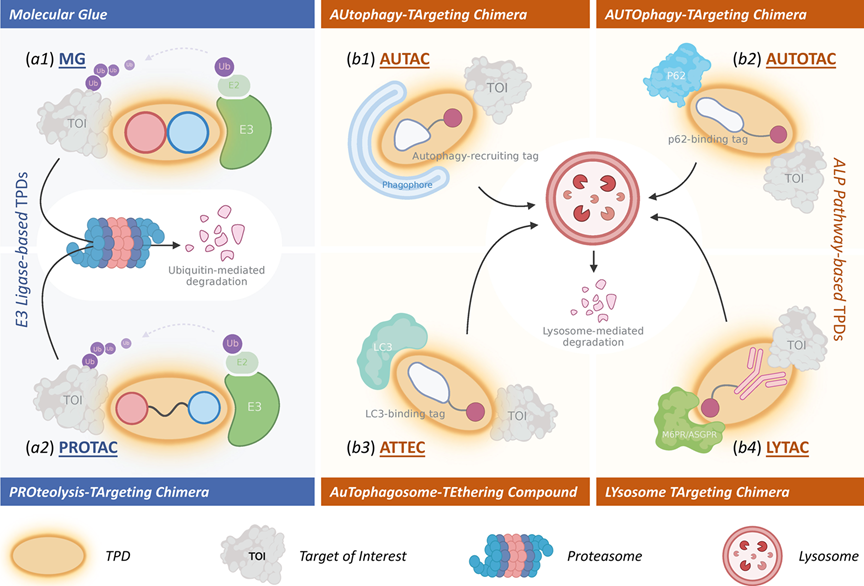
Targeted Protein Degrader (TPD) has emerged in the past decade as a major new drug modality of transformative paradigm, offering a powerful strategy to catalytically remove disease-related proteins, especially those having long been considered as undruggable. As illustrated in the figure below, there are two types of TPD: a) E3 Ligase-based, including molecular glue (MG), proteolysis-targeting chimera (PROTAC), etc.; b) ALP Pathway-based, including AUtophagy-targeting chimera (AUTAC), AUTOphagy-targeting chimera (AUTOTAC), lysosome targeting chimera (LYTAC) and autophagosome-tethering compound (ATTEC). Till now, three TPDs have been approved by U.S. FDA and >30 are currently tested in clinical trials. The detailed pharmaceutical knowledge of TPD, such as target of interest (TOI), degradation ability, disease cell activity, E3/ALP affinity, and TPD structure & physicochemical property, are found crucial for expanding the degradable proteome using selective molecular glue, designing the RNA-relevant PROTAC for a studied TOI, introducing new TPDs for treating intractable diseases, and so on. In other words, it is demanded to accumulate those valuable data of TPDs, which hold immense promise for addressing the challenge in treating refractory disease.